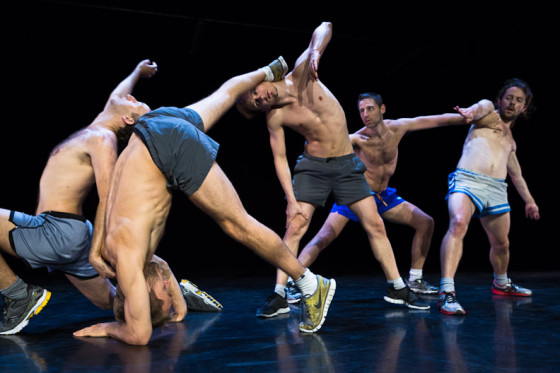
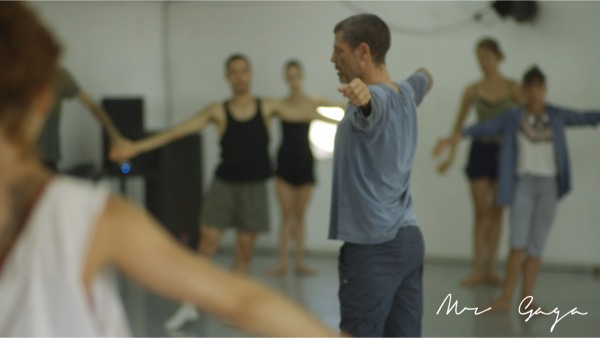
The several hour trek south from Tel Aviv to Mizpe Ramon in the Negev desert is tiring, but at the end of the journey is a refreshing oasis: Adama, an extraordinary dance center created by Liat Dror and Nir Ben-Gal. I first experienced the magic of Adama during a two-day visit in January 2008 and was thrilled to return in April 2008 for some more dancing and an interview with each of these choreographers.
I interviewed Liat after she taught a dance class for the Adama school’s students, the company members, a group of photography students visiting from Sderot, and a few “tourists” like myself who had dropped in for a few days. The mixture of people was as unique as Adama itself. Intrigued? Join us as Liat talks about how she and Nir forged a new path in Israeli contemporary dance, moved to the desert, and developed an innovative approach to healthy, healing movement.
* * *
To catch a glimpse of Liat and Nir’s groundbreaking and prize-winning Two Room Apartment (1987), which we discuss in our interview, check out the first minute of this video. The rest of the video focuses on Nir and Liat’s current work in the desert, offering an inside look at Adama and scenic views of Mizpe Ramon.
Video: Liat Dror and Nir Ben-Gal
* * *
Adama’s dancers rehearsing in April 2008.
Adama is currently gearing up for a busy summer: the company runs a summer course from July 12-17 and a teachers’ course from July 25-28. Visitors may also enjoy Adama’s Magic Summer Night from July 16-17, which includes a performance of the company’s latest work.
It’s been a particularly fascinating season at Batsheva. As the company marks the 20th anniversary of Ohad Naharin’s arrival as artistic director, it has placed a wealth of choreographic treasures onstage for review at the Suzanne Dellal Center: Hora (2009), Project 5 (2008), Three (2005), Mamootot (2003), and Kamuyot (2003).
This programming has promoted what Naharin has discussed in several press conferences: an opportunity for the choreographer, dancers, and audience members alike to revisit the choreography. Project 5, itself a compilation of excerpts stretching from 1985’s Black Milk to 2008’s B/olero and originally danced by five women, was newly presented in 2010 with an all-male cast. Three has stayed in Batsheva’s active repertory, but the recent performances were the first ones at Suzanne Dellal in a few seasons. And Mamootot and Kamuyot, which are performed in the studio with viewers on all four sides, always offer repeat audiences a new perspective simply through the choice of seating.
Ohad Naharin’s Kyr/Z/na. Photo by Gadi Dagon.
Now, together with the Batsheva Ensemble, the Batsheva Dance Company’s junior troupe, Naharin is revisiting two of his earlier works: Kyr (1990) and Z/na (1995). The result – Kyr/Z/na 2010, which combines excerpts from both works in one powerful program – continues through March 17 at the Suzanne Dellal Center in Tel Aviv.
My preview of Kyr/Z/na2010 was first published in the Jerusalem Post as “Moving Legends.”
* * *
Moving Legends
Ohad Naharin’s Kyr/Z/na. Photo by Gadi Dagon.
Reflecting on his recent restaging of excerpts from Kyr (1990) and Z/na (1995) for the Batsheva Ensemble, Ohad Naharin remarks, “At first, when I returned to the material, I felt that I was waking a dinosaur.”
The two works have certainly loomed large in the history of the Batsheva Dance Company and in the memories of Israeli dance audiences. Commissioned by the Israel Festival, Kyr was the first dance that Naharin created after assuming the artistic directorship of Batsheva in 1990, and it featured a musical collaboration between Naharin himself and the band Tractor’s Revenge. Even after two decades worth of adventurous new works, a section of Kyr set to a relentlessly driving rock version of the Passover song “Echad Mi Yodea” has remained Naharin’s best-known choreography. Meanwhile, Z/na, which opened the Israel Festival in 1995, also left a strong impact with striking images, memorable props, and an original score composed by popular music icon Ivri Lider.
Ohad Naharin’s Kyr/Z/na. Photo by Gadi Dagon.
Touching these two substantial, legendary works after so many years was, at first, daunting. “In the early stages of the process, I lost confidence about the decision to work again,” Naharin recalls. “But from the encounter with the dancers and the process in the studio, the interest returned.” Ultimately, Naharin asserts, “The age of a work, or when it was created – this is not really meaningful. It’s information like any other information, but the encounter with the material happens here and now and is connected to where we are today.”
Indeed, the upcoming performances of Kyr/Z/na 2010 at the Suzanne Dellal Center promise all the freshness and excitement of a hotly anticipated world premiere. For one thing, Naharin has revamped some the selected excerpts from Kyr and Z/na, and he is now deploying an even more developed artistry to bring out the nuances in the choreography. “There’s something zealous in this work. It was created from a place of less restraint, from this raging pressure cooker. The steam that comes out of this pot is measured,” explains Naharin about the shift in energy from the original and the current version. “The image I have [now] is of a very strong motor that works at 30%. Today this creation is in a different place. It is connected to insights from 20 years of work.”
While audiences can look forward to these more finely calibrated dynamics and to other changes, they can also expect that Kyr/Z/na2010 will deliver what the original works offered: unforgettable visual images paired with particularly powerful sound scores. From the astronaut who postures and lip-synchs to a recording of Naharin’s resonant voice to the man slowly crossing the stage as he gratingly grinds an oversize wooden noisemaker, the work is full of compelling moments that sear themselves on the viewer’s brain.
Ohad Naharin’s Kyr/Z/na. Photo by Gadi Dagon.
The vitality of this new staging is further enhanced by the creative chemistry between Naharin and Kyr/Z/na2010’s talented young performers, who range in age from their late teens to their early twenties. Noting that he typically works more with the main company and that the junior Batsheva Ensemble members are with the group for only a couple years, Naharin says that this meeting with the dancers was unique. He elaborates, “I learn a lot from them. This is a very special group, and I feel that they are upgrading me.”
The magic from the studio pours onto the stage as the Batsheva Ensemble enlivens Naharin’s choreography. When individual dancers burst into fast-paced action amidst a sea of slow motion, each one masterfully commands attention. And as a line of women tears upstage to a hard-hitting rap song, unleashing a torrent of full-bodied movement before staring down the audience, their commitment to the work and their passion for dance is palpable. As performed by the Ensemble, Kyr and Z/na are no fossilized dinosaurs. They’re living, breathtaking creations that pulse with new blood and a two-decade rich infusion of artistic insights.
On my first full day in Israel nearly two and a half years ago, I made a pilgrimage to the Suzanne Dellal Center. Although I didn’t yet grasp the scope of the complex’s activities, I had heard that this was the epicenter of the Israeli contemporary dance scene, and that was enough to make me wander through the maze of Neve Tzedek’s streets until I finally found the right spot.
Throughout my first year of research, as I attended scores of performances and classes at Suzanne Dellal, my admiration and appreciation of the center only grew. And now, as I visit the center daily, I am no less astonished by the activity it supports. Classes, rehearsals, performances, and festivals keep the studios and theaters of Suzanne Dellal busy from nine in the morning to late at night, year-round. Indeed, the numbers published by the center are remarkable: each year, the Suzanne Dellal Center boasts an astonishing 600+ performances and welcomes approximately 500,000 visitors. And since its establishment in 1989, the center has presented over 1,200 premieres – most of which are dances.
Throughout 2009, festivals and photographic exhibitions celebrated the Suzanne Dellal Center’s twentieth anniversary, calling attention to the center’s extraordinary contribution to the field of dance in Israel. Although it’s now 2010, the celebration of the center’s activities is continuing: on February 23, Minister of Education Gideon Sa’ar announced that the Suzanne Dellal Center would be awarded the Israel Prize, one of this country’s highest honors.
Chaired by Dr. Hadassah Shani, the selection committee commended the center. “In its 20 years of activity, the Suzanne Dellal Center has caused dance in Israel to take off,” they acknowledged. “The many and varied artistic endeavors of the center have spawned a new generation of artists, creators and performers, in the arena of artistic dance. Creative excellence on the center’s stage has broadened, and continues to broaden, the circle of dance lovers [in Israel]. The center’s activities opened the gates of the world’s most important dance to the Israeli dance scene and made it possible for Israel’s artistic dance to make its stamp in the international arena. This is a prize for initiators and supporters of the vision that became reality.”
The Minister of Culture and Sports, Limor Livnat, added, “The Suzanne Dellal Center is one of the most fascinating and unique centers in the field of dance in the entire world. In the 20 years since its founding, the center, under the direction of Yair Vardi, has turned into a center of pilgrimage for creators and dancers from the country and from the world. The Suzanne Dellal Center brings us much pride, and the bestowing of the Israel Prize expresses the great appreciation that we have for the center and for Yair Vardi.”
The Israel Prize will be given to the Suzanne Dellal Center by President Shimon Peres, Prime Minister Binyamin Netanyahu, Speaker of the Knesset Reuven Rivlin, President of the Supreme Court Dorit Beinisch, Mayor of Jerusalem Nir Barkat, and Minister of Education Gideon Sa’ar. The award ceremony will be held at the Jerusalem Theatre on April 20th, Israel’s Independence Day, and will be broadcast live on Channel 1.
Posted on 11 February 2010 by Deborah Friedes Galili
The flyer for the Anna Sokolow centennial exhibition in Tel Aviv. Courtesy Henia Rottenberg.
Attention dance history fans: this year is the centennial of choreographer Anna Sokolow’s birth, and her artistic achievements are being commemorated around the world, including in Israel. In this guest article, Hannah Kosstrin, who recently visited Tel Aviv to research Sokolow’s work here, reflects on Sokolow’s influence on dance in Israel and highlights upcoming centennial celebrations.
Celebration in Pictures: Anna Sokolow Centennial at the Dance Library of Israel
By Hannah Kosstrin
A new exhibit at the Dance Library of Israel celebrates the life and work of Anna Sokolow (1910-2000), whose centennial is celebrated this month. Sokolow, an American-born Jewish choreographer who worked internationally and considered Israel her second home, carved out a space for herself in the Israeli dance landscape. She first came to Tel Aviv in 1953 on the recommendation of Jerome Robbins and with the support of the America-Israel Cultural Foundation, where she worked with Sara Levi-Tanai and Inbal Yemenite Dance Group (Inbal Dance Theatre). In the early 1960s, she established her Lyric Theatre. This company was active for months out of each year, and toured cities and kibbutzim throughout Israel. Later, she choreographed for Israeli companies including Batsheva Dance Company, Bat-Dor Dance Company, Kibbutz Contemporary Dance Company, Chamber Theatre, Springboard Dance Company, and Habima. Her work touched many dancers and teachers who remain prominent in dance in Israel, including Paul Bloom, Galia Gat, Rena Gluck, Yaron Margolin, Moshe Romano, and Rena Schenfeld, and Ze’eva Cohen and Margalit Oved, who work in the United States.
With the Lyric Theatre (1962-1964), Sokolow continued to develop her performance form that she termed lyric theater, a combination of dancing and acting that blurred the lines between disciplines and created works wherein performers drew from both movement and acting bodies of knowledge. Such works include Rooms and Dreams, originally created in the U.S. and then performed by the Lyric Theatre, and Forms and Poem, for which Sokolow worked closely with Israeli dancers to mount. Sokolow was concerned foremost with truth in movement and with honesty in dancers’ performance. Using elements of the Stanislavsky Method that she garnered through a trip to Russia in 1934 and work with Elia Kazan and the Actors Studio in New York through the 1950s, Sokolow drew from performers’ own experiences to craft their characters within the context of each work. Sokolow trained in Martha Graham’s technique through her work with that company during the 1930s. Many of Sokolow’s dances from the 1930s-1940s show a strong Graham influence in her own movement via initiations by torso contractions and spirals through the back. Sokolow’s dances from the 1950s onward, however, feature pieces crafted from movement and gestures found in daily life, from running to grasping hands to slamming against a wall. Her work also presents quieter, vulnerable moments with arched backs and reaching arms, all while retaining the immediacy of movement coming from the “gut.”
Sokolow is known for making dances of social comment, and for reflecting humanity in the most inhumane of situations. Dreams (1961), an evening-length group work, contains vignettes of harrowing concentration camp scenes leading to a dignified and wrongful death, while In Memory Of…543246 (1973), a solo for Rena Schenfeld, is a portrait of a Holocaust victim. And the Disciples Departed (1967), a collaborative work with director Thomas J. Knott for American television, comments on the Vietnam war, racism in the U.S., and the rape of Kitty Genovese. Rooms (1955), Sokolow’s landmark piece that cemented her place as a canonical concert dance choreographer, exposes loneliness, urban alienation, and unrequited desire. The work is set against Kenyon Hopkins’ jazz score that alternates between driving adrenaline and stark atonal punctuations. Earlier, in the 1940s, Sokolow made dances with Jewish themes and about Biblical heroines to stand in solidarity with Jews worldwide during the Holocaust. The most well-known of these dances is Kaddish (1945), a memorial for Holocaust victims in which Sokolow defied contemporary gender conventions by laying tefillin around her arm. Sokolow kept her Jewish identity at the core of all of her work, and her time in Israel fed and reinforced this connection.
The exhibit at the Dance Library of Israel commemorates Sokolow’s career through photographs and other ephemera, and it runs through September 2010. The Dance Library of Israel is located at Beit Ariela, 25 Shaul Hamelech Boulevard in Tel Aviv. More information is on the Beit Ariela library’s blog.
For information about Sokolow Centennial celebrations outside of Israel, please visit:
Hannah Kosstrin is a Ph.D. Candidate in Dance Studies at The Ohio State University (OSU). Her dissertation project focuses on Anna Sokolow’s work from 1927-1961. It is supported by the OSU Melton Center for Jewish Studies, the P.E.O. International Sisterhood, and the OSU Department of Women’s Studies Coca-Cola Critical Difference for Women Graduate Studies Grant for Research on Women, Gender, and Gender Equity. She has performed, choreographed, and taught in Boston, MA and Columbus, OH, U.S.A.
Posted on 02 January 2010 by Deborah Friedes Galili
Video: Promo for Arkadi Zaides’s new Quiet
As guest writer Brian Schaefer wrote in his article, for most visitors from abroad, International Exposure is a veritable “crash course” in Israeli contemporary dance. For me, however, International Exposure serves another purpose. Since I’m now intimately familiar with both the scene as a whole and with the artists themselves, this festival provides an unparalleled opportunity to consider developments in the field over the last year.
While Brian rightly noted that the vast majority of works in International Exposure did not overtly address the Israeli context, a few works did tackle issues in Israeli life – and as someone who has seen the vast majority of contemporary dance created in Israel since 2007, I can vouch that this is a notable shift. Out of all the dances I watched during my first two years in the country – a number which easily surpasses 100 and probably nears 200 – I can probably count the number of works which explicitly examine Israeli culture and society on less than two hands. Most of them, such as Renana Raz’s We Have Been Called to Go, were works that had premiered in previous seasons; while I saw this dance on stage, I had to seek out other works such as Yasmeen Godder’s Strawberry Cream and Gunpowder on DVD. Indeed, when I saw Hillel Kogan’s Everything at Exposure in January 2008, its focus on Israeli machismo was such a revelation because it was the only new work I had seen which openly examined an aspect of Israeli identity.
So it was absolutely astonishing for me to watch as not just one but a handful of the offerings at International Exposure unmistakably explored Israeli society. Two of these dances had premiered just weeks earlier in the Curtain Up festival, and while they both took the relationship of the individual to the surrounding Israeli society as their main theme, they approached the subject from different personal perspectives and aesthetics.
Noa Dar’s Anu. Photo by Tamar Lamm.
In Noa Dar’s trio Anu (Us), one dancer – perhaps dressed to look younger in pigtails and a skirt – is initiated into the group, first observing her two fellow performers and then modeling herself after them until she becomes a participating member. Though at times the context is universal, there are several scenes which bear the recognizable imprint of Israeli culture. Gathered center stage in a tight circle, the trio performs a speeded-up mishmash of Israeli folk dance steps; occasionally, one dancer breaks out of the group, causing the others to pause, but then the three immediately resume their folk dance at an even more frenetic pace. Another powerful section references the army service which is compulsory in Israel. Juxtaposing stylized miming of military actions (loading, aiming, and shooting guns; throwing grenades; scoping out a building and breaking in; strip searching a suspect) with sweetly tranquil classical music, the scene is chilling.
Niv Sheinfeld and Oren Laor’s Big Mouth. Photo by Gadi Dagon.
Whereas Anu follows the process of indoctrination into society, Niv Sheinfeld and Oren Laor’s Big Mouth considers the reverse process of an individual critically considering this group mentality. The strains of an Israeli folk song set the stage even before the curtain rises, and the tone is further established as the three dancers (Sheinfeld, Laor, and Keren Levi) begin by turning their backs on the audience and striding in unison around the perimeter of the space. Gradually, the trio’s regimented marching is punctuated by Israeli folk dance steps – a mayim here, a three-step turn there – and eventually, Levi tries to break out of this seemingly never-ending pattern with her own idiosyncratic movement. Later, to the swelling melody of an Israeli military hymn, Levi stands downstage and slowly opens her mouth wide until her face is distorted in the shape of a silent, terrible scream; this simple yet virtuosic act leaves a haunting imprint even after the booming music dies down and Levi’s face returns to its normal state. Despite the tenderness with which Sheinfeld and Laor cradle Levi during their final trio, keeping her perpetually aloft while passing her back and forth, the emotion which prompted such an agonized cry clearly lingers, prompting her to leave the group at the close of the work.
Besides Anu and Big Mouth, two other brand-new works showcased in International Exposure 2009 also seemed to be colored by the political and social dynamics within the Israeli context. Rami Be’er’s choreography has often explored Israeli life, and his Infrared, which the Kibbutz Contemporary Dance Company premiered in November, seems to follow in this pattern. Though much of the choreography itself is more abstract, the work opens with a man’s voice solemnly intoning a poem (written by Be’er) about soldiers in a garden and with one dancer slowly emerging from what appears to be a body bag. Meanwhile, Arkadi Zaides’s Quiet, which was presented in a studio showing as a work-in-progress, features a mixed cast of Jewish and Arab performers and effectively plays off the tensions between these two groups.
After two years of barely seeing any choreography explicitly grappling with the Israeli context, I couldn’t help but wonder why so many dances were now openly invoking this subject and its intense undercurrents. Could it perhaps be that, after the war in Gaza last year, some choreographers felt compelled to reexamine their surroundings? What other political and personal factors were at work?
Noa Dar’s Anu. Photo by Tamar Lamm.
In a conversation with Noa Dar prior to the premiere of Anu, she said that her latest work stemmed from her experiences as “a mother and also as a citizen” of Israel. While Dar talked about how her young children’s education was already “printing on them their future and the future as soldiers,” she also recounted her experience at a protest against the incursion into Gaza in 2008, during which not only right-wing counter-protesters but also passersby cursed the demonstrators as traitors. The choreographer further discussed the media’s one-sided account of both Gaza and the 2006 Lebanon war and brought up recent legislation curtailing the rights of Arab Israelis. “This work came out of these experiences, out of this fear that this country is getting more and more closed,” Dar acknowledged. She continued, “It’s about the uniformity that Israeli culture brings and trying to explore how to survive it, to go against it but still be inside, to be able to comment on it, to try to change it.”
Niv Sheinfeld and Oren Laor’s Big Mouth. Photo by Gadi Dagon.
While these recent developments spurred the creation of Anu, Big Mouth emerged from somewhat different roots. Niv Sheinfeld and Oren Laor choreographed the dance during a period when they were frequently away from Israel; sometimes they were on tour with previous works, and at other times they were in the Netherlands where they collaborated on the new trio with Amsterdam-based Israeli dancer Keren Levi. Sheinfeld remarked, “Somehow I think it affected this work; it made the piece somehow with reference to the Israeli culture.” Laor chimed in the conversation, noting not only the physical distance of the three collaborators from Israel during the creative process but also other events which caused the artists to consider issues of nationalism and group identity. While Big Mouth does include specific allusions to the Israeli context, Sheinfeld reflected that ultimately, “the way that we treat the subject is the personal level, is the individual, and how an individual acts in a group.”
Arkadi Zaides’s Quiet. Photo courtesy of Arkadi Zaides.
Meanwhile, in the publicity for Quiet, which premieres this weekend at Tmuna Theater in Tel Aviv, Zaides explains the backdrop for his latest work. He writes:
“Quiet arose from a real sense of emergency; in light of the growing violence and mistrust between communities in Israel, constantly subjected to states of shock which never allow the space needed for reflection, and thus never allow for change. In such an environment it felt acute to create a platform which allows for an open and honest communication; a place where it is safe to let one’s demons out and set them free; where the irrationality of response is examined and emotions are bravely explored; where a broad perspective is sought and where trust is continuously built.”
With these works’ diverse reference points and perspectives, they are welcome, thought-provoking additions to the Israeli contemporary dance scene.
The works mentioned in this article are currently performed throughout Israel. To find out about upcoming concerts and to learn more about the artists, visit the websites below: