Archive | Israeli Companies

Tags: , , , , , ,

Batsheva Dance Company: Ohad Naharin’s “Shalosh” (“Three”)

Posted on 15 February 2010 by Deborah Friedes Galili

Video: Batsheva Dance Company in Ohad Naharin’s Three

Five years after its premiere, Ohad Naharin’s Shalosh (Three) still lures audiences to the Suzanne Dellal Center – and judging by the enthusiastic curtain calls last Saturday night, the work continues to captivate crowds.  My preview of this run of Three was originally published in the Jerusalem Post as “Lucky Number ‘Three.’”

* * *

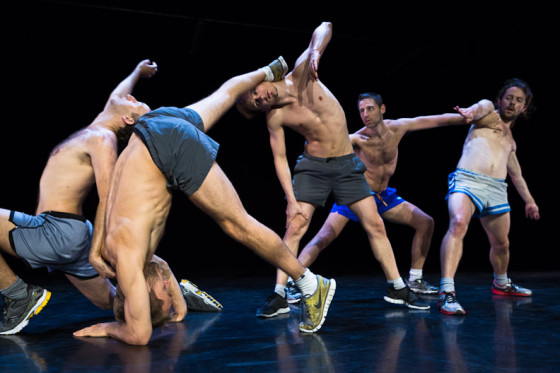
Three by Ohad Naharin.  Photo by Gadi Dagon.

Addressing a small crowd in the Batsheva Dance Company’s studios during an open rehearsal of Three, artistic director and choreographer Ohad Naharin mused that we frequently revisit books, movies, and music. So why not revisit a dance?

Naharin proposes that Tel Aviv audiences do just that when Three, an evening-length work which premiered in February 2005, returns to the Suzanne Dellal Center this weekend.

Guy Shomroni and Sharon Eyal in Three by Ohad Naharin.  Photo by Gadi Dagon.

“The showing of Three in Tel Aviv offers the viewer a renewed meeting with the work, which exists inside a constant process of development since its creation,” Naharin explained in a press release. “This process, in which the work is growing and being refined all the time, is just as meaningful in the company’s work as the process of creation before a premiere.”

At the rehearsal, Naharin elaborated why both of these processes are so vital.  “Since the premiere, the creation went through a lot of changes.  I like to think of the premiere as a birth, since it’s clear to everyone that birth is just one moment, and that afterwards many other things happen,” he reflected.  “There is no doubt that the work changed, improved, among other things because of the meeting with the dancers, who are very creative and musical themselves.  This is one of the reasons that I recommend for people to see the creation twice, at the beginning and after a year or two once it has gone through this process of ripening.”

Three by Ohad Naharin.  Photo by Gadi Dagon.

In the case of Three, the work has enjoyed five years of ripening while remaining in Batsheva’s active repertory.  Consequently, original cast members who have stayed with the company as well as newer additions to the troupe have had ample opportunity to develop their interpretation of the dance, calibrating their embodiment of the choreography with previously elusive nuances and subtleties.

Nowhere is this maturation more important and beneficial than in a work such as Three, which in the absence of complex stagecraft and elaborate visual design reveals the movement and the dancers’ performance of it as the main subject.  Lit plainly but effectively by Avi Yona Bueno (Bambi) and clothed in Rakefet Levy’s basic, solid-colored tops and closely fitting cropped pants, the dancers approach Three’s sophisticated, multi-layered movement with a confident straightforwardness.

Three by Ohad Naharin.  Photo by Gadi Dagon.

As the title suggests, Three contains three discrete sections, and Naharin’s compositional and musical choices provide each part with a distinctive feel.  In “Bellus,” set to Glenn Gould’s celebrated recording of J.S. Bach’s Goldberg Variations, a simple purity reflective of the music pervades both the dancers’ finely wrought solos and the more pared down, precise group work.  Brian Eno’s spare, evocative Neroli provides the soundscape for “Humus,” which features a flock of the company’s women methodically repositioning their bodies and shifting their spatial formation in an entrancing unison.

“Secus,” the final section, boasts a musical collage that stretches from the offbeat electronic stylings of AGF to the alluring Indian melodies of Kaho Naa Pyar Hai to the resonant harmonies of the Beach Boys.  This adventurously eclectic mix serves as a fitting backdrop for the audaciously quirky choreography.  From total stillness, the dancers burst into flurries of activity, creating a sense of organized chaos both in the space and within their bodies.  Their novel movement often defies description, but it constantly commands attention and inspires awe.

Three by Ohad Naharin.  Photo by Gadi Dagon.

Three’s extraordinarily rich physical texture can be attributed at least partly to the evolution of Naharin’s movement language, Gaga, in the early 2000s.  Naharin noted that just a few years prior to Three’s premiere, “Gaga became the heart of the daily practice of the company,” and he added, “this common language [Gaga] held the keys to the process” of making Three.  Indeed, the marvelous movement invention and robust embodiment which characterize Three are closely linked to the practice of Gaga, which expands the dancers’ ability to research movement possibilities and awakens their sensitivity to physical sensations.  Five years later, Batsheva’s dancers bring a deepened understanding of Gaga to their performance of this work.  And that’s reason enough to revisit Three for a second or even a third time.

Related Articles on Dance In Israel

Related posts on Gaga on Dance In Israel

Related Links

Comments (0)

Tags: , , , , , ,

Vertigo Dance Company in Noa Wertheim’s “Mana”

Posted on 29 January 2010 by Deborah Friedes Galili

Video: Vertigo in Noa Wertheim’s Mana

Another guest at International Exposure 2009, Talia Baruch, covers the San Francisco-area dance scene for her blog GoSee– Dance. She wrote some reviews of dances she saw here in Israel in December for her website and is generously sharing them here on Dance In Israel.

Talia’s second guest article is about Noa Wertheim’s Mana, which premiered as part of Curtain Up’s 20th anniversary and was a hit with the audience at International Exposure.  Read on to hear Talia’s take on this captivating work.

* * *

International Exposure 2009—Suzanne Dellal Dance Center | Vertigo Dance Company

By Talia Baruch

MANA
Vessel of Light

Choreography & Artistic Director: Noa Wertheim | Co-Artistic Director: Adi Sha’al | Music: Ran Bagno | Percussion: Dani Makov | Stage & Costume Design: Rakefet Levy | Lighting Design: Dani Fishof | Still photography: Gadi Dagon | Review & Copywriting: Talia Baruch

Mana dances the tension between container and contained, exterior and interior, whole and hollow.

And what is installed first, vessel or light?
Does the Sun rise to fill in the absence of Moonlight, or rather is it the lack of Moonlight that creates the inspiration of its vessel, container of light?
(Based on the Zohar)

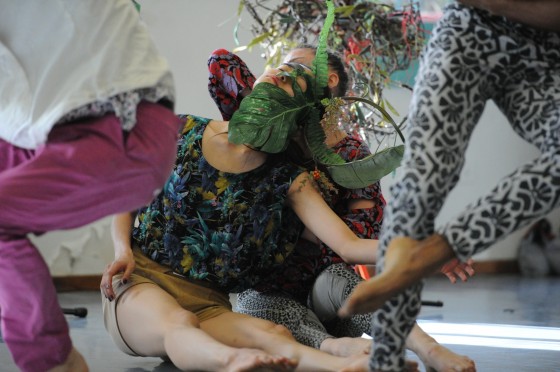
Noa Wertheim’s Mana. Photo by Gadi Dagon.

Noa Wertheim’s Mana. Photo by Gadi Dagon.

This timeless tale follows the flow in black and white, with few specks of ruddy-warm.  The bewitching-dark night stands in still, mystical contrast to the milky-white house, symmetrically centered in its simple stable form on stage.

Geometric shapes will now act out the dialogue between feminine and masculine, draw the drama between the forces of life that forever struggle to compliment each other:

Feminine: circular, soft black balloon, hanging like a full moon, up above the house

Masculine: pointy, sharp angular triangular roof, edgy rectangular door, protruding

Feminine: curve and crave in sensual, spiral hip-stirred movements

Masculine: stride, high-strung, across the stage in “connect-the-dot”-like linear routes

Noa Wertheim’s Mana. Photo by Gadi Dagon.

Both forces aspire to escape the hollow and reach the whole in this quest to be holistically contained and content. The visual image interlaced throughout the show is of a black balloon attached to a dancer, pulling her up, tall, stretching out for perfection, her white legs long and strong, trotting like a royal horse in a parade.

Noa Wertheim’s Mana. Photo by Gadi Dagon.

At first glance, the fully dressed, almost orthodox, costumes communicate a puritan, reserved modesty.  But quite quickly, a bare foot peeking under heavy garment, an escaping white shoulder, a curving contour, a tight waistline, a hip, lend to a sensual, lustful, communication.  The free-fall back bends and suicidal leaps shatter the quiet, restrained recital.

Noa Wertheim’s Mana. Photo by Gadi Dagon.

The music drapes the dancers like a fitted gown, in sync, in tune. I play the soundtrack CD over and over and give in to the lyric mood quietly setting in.  Ran Bagno, who has been working hand in hand with Vertigo’s mom and pap (Noa and Adi), wrote the score and played all the instruments, except for percussion, tapped by Dani Makov.  I sit with Bagno over cappuccino on a sunny winter day in down town Tel Aviv and ask him about the creative process of piecing music for this show. “Unlike some other dances, Mana isn’t a collage of fragmented scenes,” he says, “rather, it’s composed as a single, comprehensive piece. When Noa came out with the idea of a ‘vessel holding light’ I struggled to find just the right musical instrument to fit in…until I stumbled over my kid’s old, abandoned guitar. Something about its virgin, broken, acoustic sound was perfect for infusing the muse.”

Noa Wertheim’s Mana. Photo by Gadi Dagon.

Watching the fluid flow of movement on stage, I’m reminded of Alexander Calder’s art — capturing compound sketches in one single line stroke.  The expression captured in Mana carries the visual aesthetics of calligraphy: fine brush, dipped in black ink, forms a black blotch over snow white paper.  Then, in a single skilled hand, it drifts, pulling up tall, lying low, and spiraling all the way through.

Noa Wertheim’s Mana. Photo by Gadi Dagon.

Vertigo Dance Company founded the pea-green Eco Art Village, where they live and create in a little utopian planet of clean air and fresh manure: http://www.eco-artvillage.org/index_eng.asp. This might explain why their work is genuinely untainted, raw and earthly.

Talia Baruch is a writer and translator covering the dance/theater scene in San Francisco, where she has been living for the past 11 years. She is the founder of Copyous, providing creative copywriting and Localization Strategies. The ingredients that shaped her life are the explosive dance scene in urban Tel Aviv, where she grew up, the pea-green English country side, where she inhaled a handsome amount of fresh-manure & horseback-countered through endless woods, and the 24/7 Localization/Internationalization business bustle, that put perspective to it all. www.copyous.com

Related Articles on Dance In Israel

Related Links

Comments (0)

Tags: , , , , , , , , ,

Batsheva Dance Company: Ohad Naharin’s “Project 5″

Posted on 19 January 2010 by Deborah Friedes Galili


Video: Batsheva Dance Company in Ohad Naharin’s Project 5

Given the chance, I usually prefer to see a dance twice.  I can anticipate the choreography and more strategically direct my gaze, and I detetct nuances that I missed the first time around.

I first saw Batsheva Dance Company in Ohad Naharin’s Project 5 when it premiered in 2008, and by the time I had my second viewing last week, there had been a significant change: the gender of the dancers.  Originally created for five female dancers, Project 5 is now being performed not only by women but also by men.

I had wondered if I would sense differences between the male version and the female version of Project 5.  Without watching the versions back-to-back, it was challenging to make a fair comparison.  Instead, as I watched the men, I found myself thoroughly absorbed in noticing the subtle idiosyncrasies among individuals both within this particular quintet and across the two casts I had seen. Project 5’s assortment of small groupings and repeated compositional motifs provide ample opportunity to observe each dancer in all his (or her) glory and discover each performer’s winning quirks.

Those of you in Israel can catch both female and male casts in Project 5 at the Suzanne Dellal Center from January 28-30.  For those of you who aren’t in the country, you can get your Batsheva fix online by browsing their fantastic new website (link below; English version to come shortly!).

My preview of Project 5 was originally published as “Changing Places” in the Jerusalem Post.

* * *

Changing Places

Two dancers rhythmically swing their forearms side to side as Isao Tomita’s synthesizer transforms the stirring melody of Ravel’s Bolero.  Positioned squarely behind microphones, three dancers intersperse their stern monotone chanting with more dynamically accented gestures.  Five dancers add movement after movement to a gradually accumulating phrase, striking their abdomens with a resounding slap each time a woman’s voice matter-of-factly intones one particular line from Charles Bukowski’s “Making It.”  And finally, costumed in flowing white fabric, five dancers shoot through the space in soaring jumps and ritualistically smear mud across their faces and chests.

Are these dancers men or women?  The answer depends on which performance of Ohad Naharin’s Project 5 you attend.

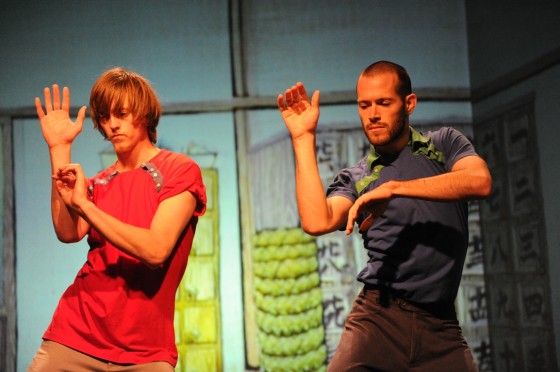
Ohad Naharin’s Project 5. Photo by Gadi Dagon.

Naharin first presented Project 5 in 2008 to showcase five female dancers who had recently been promoted to the Batsheva Dance Company from the junior Batsheva Ensemble.  Besides displaying the formidable talents of these up-and-coming dancers, Project 5 unearthed several gems from the rich landscape of Naharin’s repertory.  The engrossing trio “Park” hails from Moshe (1999), the finely crafted quintet set to Bukowski’s instructive text and Arvo Pärt’s “Für Alina” is from George and Zalman (2006), and Black Milk, the supremely athletic closing section for five dancers, was first performed in 1985.  “B/olero,” the duet with its hypnotizing loops of movement, was the only section created in 2008 for members of the original Project 5 cast.

Ohad Naharin’s Project 5. Photo by Gadi Dagon.

In its early performances, the chance to see five of Batsheva’s freshest female dancers featured in this intimate chamber setting was reason enough to go to the theater.  But now Naharin is upping the ante, offering a rare opportunity to see the exact same choreography in both a female version and a male version.  During the production’s latest run at the Suzanne Dellal Center, two all-male and two all-female casts are performing Project 5.

Ohad Naharin’s Project 5. Photo by Gadi Dagon.

While reversing the casting of men and women in a classical ballet would be unthinkable because of the genre’s gender norms, switching the genders in Naharin’s choreography is an intriguing novelty that fits comfortably into the realm of possibility.  Indeed, regarding the materials with which his dancers work during the creative process, Naharin explains, “it is possible to talk, among other things, about musicality, accuracy, groove, passion, the ability to sublimate personal madness as an aid for creation, connection to sexuality and more, and all these things are not connected to gender and are not the property of men or of women.”

“The difference,” Naharin notes, “lies in the different point of reference of the viewer – in social conventions, our habits, and the awareness that a man does a woman’s role.”

Ohad Naharin’s Project 5. Photo by Gadi Dagon.

Naharin’s assertion is supported by veteran Batsheva dancer Guy Shomroni’s experience in working on Project 5.  Asked if it felt significantly different to step into roles originated by women, Shomroni replied, “Frankly, not really, because the starting point for us as dancers in this company is usually coming from a more physical way.”  Rather than taking on specifically gender-coded movement or characters, Shomroni and his fellow male dancers were charged with the same basic physical tasks that their female predecessors faced.

Ohad Naharin’s Project 5. Photo by Gadi Dagon.

Yet there was a high level of excitement for the new male cast when it came to learning Project 5.  Shomroni reflects that besides Black Milk, which has frequently been performed by a male quintet, “None of the material was ever offered for men to do . . . to touch this product after it’s already been through a process and a maturing on stage, it’s a nice experience.”

Ohad Naharin’s Project 5. Photo by Gadi Dagon.

As for the audience’s perspective, Shomroni muses that the differences among dancers of the same gender may be as fascinating as the contrasts between the male and female casts. In a company full of strikingly individual dancers, each of whom is uniquely compelling, this may well be the case. Yet returning to the issue of gender, Shomroni adds thoughtfully, “there is a difference in the body shape and the body curves in the way the body is built, so maybe there is going to be some type of change. Tell me if you find some.”

Related Articles on Dance In Israel

Related Links

Comments (0)

Tags: , , , , , ,

Kibbutz Contemporary Dance Company in Rami Be’er’s “InfraRed”

Posted on 10 January 2010 by Deborah Friedes Galili

Video: KCDC in Rami Be’er’s Infrared

Another guest at International Exposure 2009, Talia Baruch, covers the San Francisco-area dance scene for her blog GoSee– Dance. She wrote some reviews of dances she saw here in Israel in December for her website and is generously sharing them here on Dance In Israel.

Talia’s first guest article is about Rami Be’er’s InfraRed, which was mentioned in my last post about the festival.  Read on to learn more about this work, Be’er, and the Kibbutz Contemporary Dance Company.

* * *

International Exposure 2009—Suzanne Dellal Dance Center | KCDC

By Talia Baruch

INFRARED

Choreography, Stage Design, Lighting Design: Rami Be’er | Costume Design: Maor Tzabar | Sound Design: Alex Claude | Still photography: Gadi Dagon | Review & Copywriting: Talia Baruch

A black garden is revealed.
An invisible world is unveiled through infrared light spectrum.
Black bodies expose colors.

IN THE BLACK GARDEN

Lyrics and music: Rami Be’er
Translated from Hebrew: Talia Baruch

In the black garden
Red soldier—watch
Blue soldier—warn
Yellow soldier—shoot all
(Back to. The wall.)

In the black garden
Red soldier—respond
Blue soldier—drop
Yellow soldier—yell
(Get used to hell)

In the black garden
Red soldier—reply
Blue soldier—hush
Yellow soldier—weep
(In the shit. Deep)

In the black garden
Red soldier—gape
Blue soldier—loll
Yellow soldier—hallucinate
(Feel the pain, mate?)

In the black garden…
A soldier stares
A soldier strays
A soldier errs

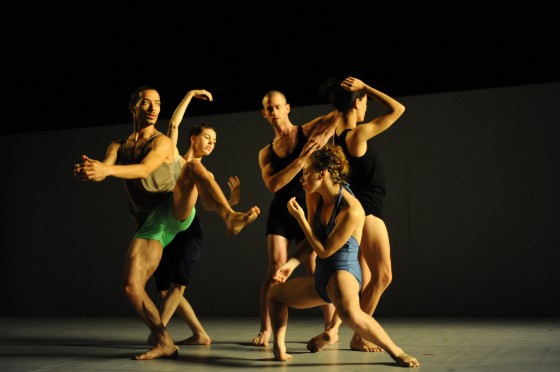
Rami Be’er’s InfraRed. Photo by Gadi Dagon.

A deep voice delivers the weight of “In the Black Garden” to the taps of a black platoon.  They open the show and they’ll also close it, but not just yet.   We’re still in for a journey, exploring the tumbles of our human condition, sinking deep into its weaknesses, aspiring to new heights through time and space.

Music is at the forefront of Be’er’s dance compositions.  He writes the lyrics & tunes, mixes the electronic sound effects and plays the cello pieces. The opening scene carries you over to another planet, both locally familiar and exotically estranged.  A wind storm echoes. Soft oasis waves flutter, lulling you into the Sahara mood, a blazing desert sweeping in like a yellow sea.

The drama sets off with bodies, humans and creatures, pacing through.  I quake in my seat, feeling a sudden urge to stretch right out of my spine, when the four-legged creature enters.  You know she’s coming out when you hear the slow somber score greeting her cue, like in Peter & the Wolf.  Her long black hair glides down to the floor, heavy, with every stretch of muscle elongating her back and limbs, like a preying tiger, graceful and ready to pounce.  Her movement is from another dimension, arching, curving, hands turned backward, magnetized to the floor.  She shifts back and forth, stretching like sticky gum out of its glued grip.

Rami Be’er’s InfraRed. Photo by Gadi Dagon.

Another twitching image is the cocoon, tightly swaddled: legs breaking out of colored paper wrap, muffling.
Soundtrack creaks:
-..I can’t dance it anymore
’cause my feet don’t touch the floor…-

The framework image for this dance is a board game.  And on it players make their moves.  They represent the three core colors: red, blue and yellow. Then there’s black, absorbing all colors, and white, their void.

Be’er was inspired by Sergeant Pepper’s album cover and commissioned the costume to reflect that 19th-century-European-soldier-uniform look, with the long flap buttoned apparel, set in the three foundation colors.  Like players on a check board, the dancers move through space in forward/backward horizontal/vertical taps, at times restrained within the confinements of red, blue and yellow squares laid out on the platform.

About KCDC–Kibbutz Contemporary Dance Company

KCDC was founded in 1970 by Yehudit Arnon, who directed it through 1996, as an extension of the Ga’aton Repertoire Dance group.  Today the company’s work is identified by the compositions of its Artistic Director—Rami Be’er, who also runs KCDC 2, the young company.

KCDC simultaneously holds 5-6 different dance productions and tours globally.

About Rami Be’er

Rami Be’er was born and raised on Kibbutz Ga’aton in the Western Galilee, northern Israel.  Music and art were his bread and butter growing up. His father played violin, his sisters played viola and violin and Rami picked up cello.  After completing his mandatory military service, he found himself at a junction: Should he follow a promising music career or pursue a newly explored path in dance?

Motivated by his life-long mentor and teacher, Yehudit Arnon, Be’er voted for the latter, reasoning that composing dance integrated most other stage art forms: music, design and lighting.  Rami’s drawing and sculpting background is manifested in the stage and costume design, his passion for music is unleashed in the way he pieces together the soundtrack, and his aesthetic vision is carefully crafted into the lighting design.

“I concoct a total experience of music, text, visual and movement,” says Rami, “taking in my impressions of the bounty all around.” “Dance is a way of life for me. I believe that any art form touches on our human condition and arouses existential explorations. I invite the audience to a journey. I provide the tip of the rope, and leave a wide range for individual interpretation and connotation.”

When asked what are his sources of inspiration, Rami replies that it can be a song he hears, a curious object, the angle in which a sun ray falls on a leaf, pregnant with rain due.

Be’er’s parents, Holocaust survivals, were members, along with Yehudit Arnon, in the commune that founded Kibbutz Ga’aton. Rami joined KCDC in 1980 as a dancer and house choreographer and rapidly made his mark.  He has since created over 40 full-piece productions for the company, leaving his signature footprint along the way.  Be’er produces at a pace of 1-2 full soirée shows a year, turning the corner for KCDC, now a globally renowned dance company.

About International Dance Village

Far away, on the other side of the rainbow, there is a little village, an International Dance Village, where dance students from around the world congregate to create.  When I came to visit, there were people dancing on dirt foot paths, behind glass doors, across lawns.  This is a unique program, initiated by Rami Be’er in 2008 on Kibbutz Ga’aton, where KCDC breaths and works.

“The extensive Ga’aton and neighboring community are engaged in this initiative, funded by Raaya Strauss.  The kibbutz communal dining hall, named “Beit Raaya,” was converted into 2 spacious dance studios, flushed with morning sun light, where KCDC rehearses daily.  There are 6 additional studios on site, with a little “home made” café where dancers and community members hang out and chill.  Once a month, on a Saturday, a collaboration between KCDC, Keshet Eylong and Teva Yechiam hostel offers a unique weekend get-away package of dance, music and pampering in the pea-green Kibbutz setting.

“There is a pyramid at the heart of kibbutz Ga’aton,” says Rami Be’er. At the top there lies the performing KCDC, then there’s KCDC 2 and Masa (“Journey” in Hebrew). The surrounding community consists of the supporting foundation of this structure. Masa is a dance immersion program that brings dance students from across the globe for a period of 5 months on the kibbutz. There is no other program like it in the world.

The literal meaning of kibbutz is a collective gathering, but there is also a double meaning in the term Kibbutz galuyot, which means an international collective gathering.  And that is what the International Dance Village is all about: a little colony of people nurturing one another, living, expressing and creating ensemble.

Talia Baruch is a writer and translator covering the dance/theater scene in San Francisco, where she has been living for the past 11 years. She is the founder of Copyous, providing creative copywriting and Localization Strategies. The ingredients that shaped her life are the explosive dance scene in urban Tel Aviv, where she grew up, the pea-green English country side, where she inhaled a handsome amount of fresh-manure & horseback-countered through endless woods, and the 24/7 Localization/Internationalization business bustle, that put perspective to it all. www.copyous.com

* * *

Related Articles on Dance In Israel

Related Links

Comments Off

Tags: , ,

Isis: Performing Belly Dance and Tikun Olam

Posted on 08 December 2009 by Deborah Friedes Galili

Video: Isis, the Jerusalem Bellydance Ensemble

Though I typically focus my writing on contemporary dance, I was willing to step outside my area of expertise to cover a belly dance group for the Jerusalem Post.  Once I found out that the group’s upcoming performance was a benefit for the Jerusalem Rape Crisis Center in Memory of Linda Feldman (JRCC), I was more than willing to take on the assignment.  What could be better than learning about a group that’s dancing for a good cause?

You can support Isis and its cause – and enjoy a night of belly dance – by attending From Isis with Love at Beit Shmuel in Jerusalem on Saturday, December 12 at 8:00 p.m.  Tickets are 75 NIS at the door or may be purchased in advance for 65 NIS at 02-6203456.  Proceeds will be donated to the JRCC.

This article was first published in the Jerusalem Post as “Belly Dancers Perform Tikun Olam.”

* * *

Belly Dancers Perform Tikun Olam

Dancer and choreographer Dorit Yeyni’s voice is rich with warm tones as she remembers planning the inaugural performance of Isis, her Jerusalem-based belly dance group, in 2007.  “I sat with the dancers and I said, ‘We have to find something special for this group. We have to give.  To get, you have to give,’” she recalls.  Thus began the group’s tradition of performing tikun olam, literally “fixing the world,” by performing belly dance and donating the proceeds to charity.  On December 12 at Beit Shmuel in Jerusalem, Isis will hold its third annual benefit, From Isis with Love, for the Jerusalem Rape Crisis Center in Memory of Linda Feldman (JRCC).

When Yeyni surveyed organizations in need for Isis’s first concert, the JRCC attracted her attention.  Not only could the JRCC use the donation, but the center’s mission – aiding local victims of sexual violence – seemed to be a perfect match for a group composed of women.  Isis’s twenty members, who range in age from 24 to 60 and include university students as well as grandmothers, not only intend to contribute financially to the JRCC but are also planning several belly dance workshops at the organization’s shelters during Hanukkah.

Isis

Isis.  Photo by Oren Drachman.

People often envision one woman dancing by herself when they think of belly dance, but Isis has popularized a mass performance style that packs a powerful impact.  Yeyni often choreographs dances for all twenty of Isis’s members, expertly maneuvering them across the stage in intricate patterns.  Clad in vibrantly colorful and dazzlingly ornate costumes made by Yeyni herself, the women dance in a carefully coordinated unison that amplifies every sway and shake of their bodies.

Dorit Yeyni

Dorit Yeyni.  Photo by Gali Tibon.

Isis is also making a name for itself with its unique fusion of influences.  In Yeyni’s choreography, the rippling arms, rolling undulations, and percussive isolations of traditional belly dance are paired with movements from other genres that she has performed. “Most of the choreography that I’m doing [has an] influence from the Israeli folklore, because I’m dancing Israeli folklore,” Yeyni notes. “I’m also dancing flamenco and ballroom dancing, and you can see the influence of all these dancing styles in my belly dance with my group. It’s very special, and it’s something new in Israel.”

For From Isis with Love, Yeyni has choreographed several new dances designed to entrance and entertain.  One of them, Shamadan, features three women wearing candelabras on their head. “It’s very beautiful and it’s very symbolic because [the concert falls on] one of the first nerot [candles] of Hanukkah,” says Yeyni.  In other dances, the performers artfully manipulate other eye-catching props such as gauzy veils, glinting swords, jingling tambourines, and flowing oversized fabric attached to the costumes that Yeyni calls “Isis wings.”

Isis

Isis.  Photo by Oren Drachman.

While Isis will perform most of the evening’s dances, the group is also hosting several guest artists on its benefit concert for the JRCC. Celebrated belly dancers Nataly Dvir, Andrea, and Rose Shabbat promise to charm the audience with their own creative interpretations of the dance form.  Hora Rishonim, one of the country’s most renowned Israeli folklore dance groups, will add a different flavor to the evening and rouse the crowd with its contagious energy.

As Yeyni describes her company’s upcoming performance, it’s clear that From Isis with Love is a fitting name.  A deep love for belly dance unites Isis’s remarkably diverse members, and all of the dancers are passionately committed to the JRCC’s cause. “We are very glad to do [this benefit] and to help,” Yeyni emphasizes. “We are doing it with pleasure.”

Related Links

Comments (0)

Advertise Here

Resources for you

Search (posts) for: